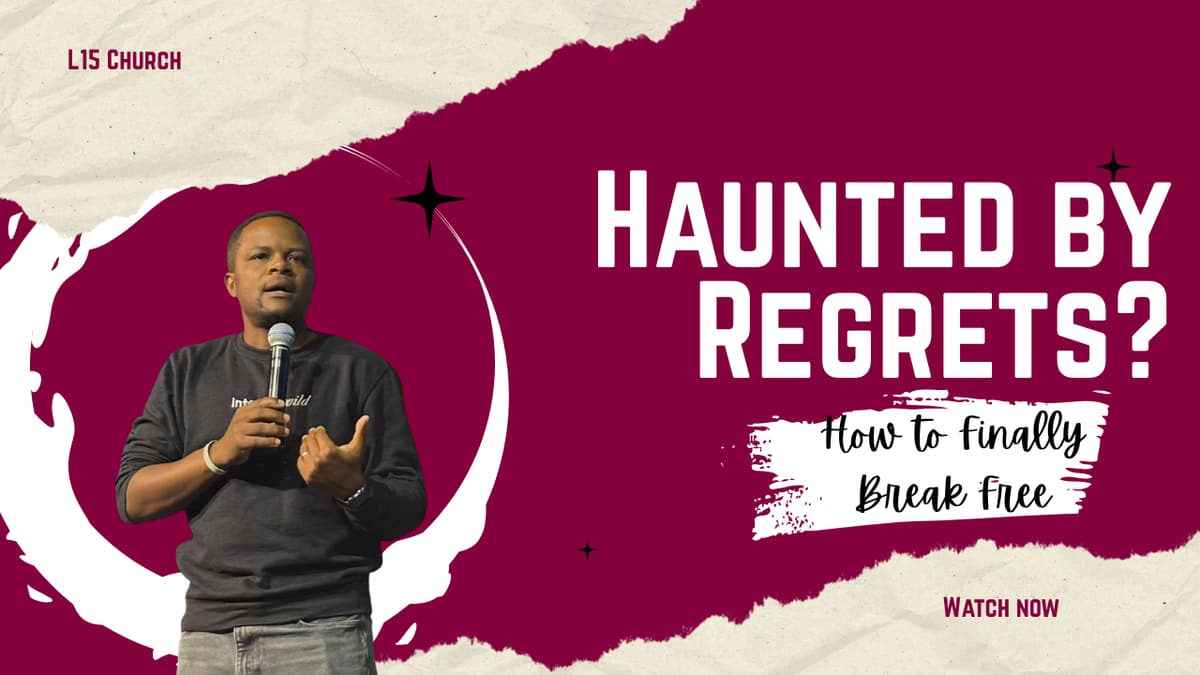
Haunted by Regrets? How to Finally Break Free.
Summary
If you could talk to your younger self, what would you say? Oz Muwaniri explains how regrets we don't deal with turn into guilt, and guilt left unchecked becomes shame that ambushes us when we least expect it. He tells how, at 13 in boarding school in Zimbabwe, he spotted a mistake on his best friend Wellington's report card and reported it, and how that moment still came back to haunt him 25 years later. The uncomfortable truth is that for the regrets that are about our own actions, the first step is to admit it: I did it. You cannot silence what you refuse to confront. In Luke 15:11-24, Jesus tells of a son who takes his inheritance early, wastes it and ends up feeding pigs. When he comes to his senses he heads home, rehearsing a speech about being a hired servant. But the father runs to meet him and sees a son, not a servant. Your past does not disqualify your present with God. The key to forgiving yourself is to accept God's forgiveness. God won't force you, but his arms are open: come home.
Key points
- Regrets we don't deal with become guilt, and guilt left unchecked becomes shame.
- You cannot silence what you refuse to confront. Healing starts with admitting "I did it."
- Shame makes us double down in a crisis. Coming to our senses means turning back home.
- Don't define yourself by your mistakes. The father saw a son, not a servant.
- Your past does not disqualify your present with God. The key to forgiving yourself is accepting God's forgiveness.
Main Bible passages
- Luke 15:11-24
- Luke 15:1-2
- Luke 23:34
Questions this talk answers
How do I stop being haunted by regret?
- Start by honestly admitting what you did, because you can't silence what you refuse to confront. Then bring it to God. The key to forgiving yourself is accepting the forgiveness God freely offers.
What is the story of the lost son about?
- In Luke 15 Jesus tells of a son who wastes his inheritance and comes home expecting to be treated as a servant. His father runs to welcome him as a son. It shows how God sees us: not defined by our mistakes, but loved and welcomed home.
Can God forgive anything I've done?
- Your past does not disqualify your present relationship with God. Like the father in Luke 15, God is waiting with open arms. He won't force you, but the invitation to come home is real.
What is the difference between guilt and shame?
- In this talk, guilt is what regret becomes when we don't deal with it, and shame is what guilt becomes when it's left unchecked, when we start defining ourselves by what we've done. God invites us to define ourselves by how he sees us instead.
About this talk
Are you constantly replaying past mistakes? Do your regrets feel like a heavy weight you just can't shake? You aren't alone. In this video, we dive into the powerful story of the lost sons in Luke 15:11-24 to discover how to finally break free from the shame that hounds and haunts us.
Whether you feel like you've wasted time, ruined opportunities, or drifted too far from home, this message is for you. We'll look at the "pig pen" moments of life and, more importantly, the radical, running response of the Father when we decide to turn back.
Scripture
Series
Full transcript
Automatically generated from the video captions and lightly tidied, so expect the odd misheard word.
So, if you could go back in time and talk to your younger self, what would you say? I know what I would say. I would go back about 20-something years ago, maybe 22 to be exact. I know 22 is an exact number, but I'll tell you why. And I would tell my younger self, "Stop supporting Arsenal Football Club. There's going to be 22 years There's going to be 22 years of pain.
Don't do it. Just don't do it." I know some of you will be like, "I don't don't send that text at 2:00 a.m. At night after you've had one too many telling your boss exactly what you think of them." You know, you'd go back and change that. Or maybe ladies, you'll go back and you tell your younger self, "Please don't date Tony. Please leave Tony alone. He's not for us.
He's not for us." And maybe Tony will go back and say, "Please don't take Clarissa to the Debs. Please don't do it." We all have these things we would change. And despite what Disney tells us, that you know, there're multi-universes, you know, parallel universes and you can change and just go back and everything is fine. No, that's not how life works. So, we are filled with these And when these regrets are not dealt with, they become guilt. And when this guilt is not kept in check, it becomes shame.
And then, before you know it, this guilt and shame just sticks with you and hits you at the most inopportune time when you least expect it. You we you will be hounded haunted by your regrets saying I know what you did last summer. I know it. I tell you cuz one time I went back to Zimbabwe. So, I'm originally from Zimbabwe although I've been here most of my life, but I'm originally from Zimbabwe. So, I went back to visit friends and I was visiting a friend of mine called Wellington.
One of my really good friends, especially in school as we were coming up. And I was just so excited to tell him, "You won't believe it. Guess who's becoming a pastor?" You know, so I just like surprise, you know, so I would just tell him and he'll be shocked, you know, you know, cuz if you knew me back then you'd be like, "What? You a pastor?" You know, but anyway, so I was going to surprise him with this. The moment I met up with Wellington in from nowhere this guilt just washed over me. This sense of shame.
I felt that I needed to apologize to Wellington. Apologize for what? For something I had done 25 years prior. That I had already apologized for. But it came on me unexpectedly. Cuz you see when I was 13 you know, Wellington and me we were tight.
We shared everything. We went to boarding school. We were inseparable. The second last day of school we got our report cards. And I was number 53 out of 183 students. Which was quite decent.
It wasn't right. But then my friend Wellington he was number five. Woo! I was happy for him. No, I wasn't. I was like, "Oh buddy, oh pal, can I see your report card cuz I don't know how you did better than me." So, he gave me his report card.
And I meticulously went through it. And I found it. The teacher had made a mistake. So, Wellington wasn't supposed to be number five. He was supposed to be like number 58. And I knew it.
So, being a good friend that I am, I marched over to the teacher and told him where things had gone wrong. So, they corrected the paper, and I cannot you know, the words of those of that teacher haunts me. He said, "Some friend you are. Some friend you are." Handed me back the report card. And it hit me what I'd done. And I go, I hand Wellington his report card.
And first it was confusion, right? I was number five, now I'm number 58. And then it started to dawn on him what I had done. And it was just hurt. And he just began to cry. And I just knew that I had done wrong.
And that has stayed with me for years and years. And from nowhere sometimes, it just haunts me. You know, it's like, "Okay, maybe two years I was gone, but you know, here I'm back." You know, two years has gone, but here I'm back. And I'm like, "What do I do with this?" Because if you do not deal with your it gets worse. But here's the thing. Here's the uncomfortable truth about If there is something that you regret, and I'm talking about regret over something that you did, not something that was done to you, something that you I did it.
That's the uncomfortable truth. I did it. It wasn't my friends. It wasn't my upbringing. It wasn't my parents. I did it.
And here's the uncomfortable truth about any regrets that you have for the actions that you did. You did You did it. And here's the thing. You cannot silence what you refuse to confront. So, that first step is to go did it. That is the first step of healing.
But then, we don't stop there. You're supposed to go to the next step. When you admit it, you can go one of two But I'm hoping that from this sermon you will take the right way. So, this is now I'm going to go to the story that we read. So, I'm just going to retell some things. So, this is a story about a young man.
Right? A young man who goes to his father and he says to his father, "Hey Dad, you're kind of taking too long to die there. Right? Can I have what's coming to me?" And this is really bad cuz even in our country we have laws against this kind of stuff. Right? You cannot force, for instance, your elderly parents into the nursing home so that you can take their house.
You cannot do this. This is against the We've got laws against this kind of stuff. It's bad. But this guy is like, "Hey Dad, give me what's coming to me." And the dad agrees and gives it to him. And then to make matters worse, he travels to the big smoke, right? He goes to Dublin.
And he spends all his money, right? In reckless living. I'm like, "Stay in Galway. What are you doing in I'm sorry my Dubliners, but what are you doing in Dublin? You stay in Galway. But he goes to Dublin.
And he squanders all his money in reckless living. And then he began to be in need. So, one question I need to ask you is, why didn't he go to his parents at that moment? Why didn't he go to his The shame had taken hold of him. The guilt. So, when that crisis came, the shame had him not do anything.
It had him double down. So, what about for you when that crisis When COVID hit, did you double down on your shame and your guilt? Or when you got fired because of your behavior, did you double down on it? Or maybe when you sabotaged your marriage, your relationships, when that crisis came and divorce was looming, did you double down on it? When you the life savings of your family because of your addiction, did you double down on it? Or was that the moment of crisis where you saw a silver lining and said, "Something has to change."?
But for this young man, he doubled down. So, listen to what he did. So, he went and hired himself out to one of the citizens of that country who sent him into the field to feed pigs. I mean, for us it doesn't seem as bad, right? Because we all like pork, right? Who doesn't like bacon?
Come on now. But for a Jewish person this was hitting rock bottom. This is This is similar to a vegetarian going to work in a slaughterhouse killing animals. What do you think is vegetarian buddies would think about They would not like that one bit, but this is what shame got this young man into. So guys we have to deal with our guilt, with our shame, with our regrets. And I mean, one of the things, right?
I would rather not deal with my shame and my guilt. I would rather those guys in Silicon Valley, right? That they come up with like a universal remote that you can just mute guilt. Wouldn't that be good? I think that would be a best seller, don't you think? Like it would sell better than cell phones.
I tell you that. Like just a button where you can just go click and you don't feel guilty. I mean, you'd have families fighting over it. You had the remote for too long. It's time It's my time to mute my thoughts and my shame and my guilt. But guys, life doesn't work that way.
And this is where I love verse 17. Like it talks about Sorry, I think I didn't get it in the slide, but it's in my head. It says when he came to his senses. When he came to himself. So, in other words, when he decided to confront what he had done. Cuz he had what?
He had done it. He had done it. But he decided to confront what he did. So, that's the first you have to admit what you have done. The next step is what this young man He goes to his father. Or he decides to go to his father.
But, but, but there is something in what he says, right? He "I will go to my father, and I will say, I have sinned against God and I have sinned against you. I am no longer worthy to be called your son, right? I'm no longer deserving to be called your son." If you're not you're going to start to define yourself by your mistakes. You're going to look at your mistakes, and that's how you're going to define Let me tell you, there are plenty of people who would do that for you. Don't do it.
Don't do it yourself. I'm telling you. In verse 1 and 2, the reason why Jesus tells these parables has to do with Jesus was hanging out with sinners and tax collectors, right? He was just hanging out. Jesus would just hang out with people. Jesus liked to go to parties, guys.
If you didn't you know, Jesus would just hang out. And then there were people who were saying, "How dare you hang out with tax collectors and sinners?" And that's why Jesus tells this story. That you know what? You are seeing them in a certain light that I don't see them. Right? I see my sons and my daughters who are just lost and they need guidance.
But you are seeing people you want to shun. That's not how I see them. So, guys, don't do it. Don't do it. Don't don't don't redefine yourself. Don't define who you are by what you have done wrong.
Define yourself by how God sees you. So now here's the thing, how does God see you? So when this young man returns like with the with this little speed speech, right? Oh, just treat me like a servant, right? I'm a servant, just treat me a servant. And the father sees him at a distance and has compassion on him.
And he runs out to him. I mean, in the Middle Eastern culture, I hear that was just undignified to have a grown man run out to himself to his son and just do PDA right in public like that. Just be kissing the guy, you know, you know, just be slobbering all over him, but he was just so happy to see him. Because you see, the father did not define the son by what the son had done. The father, when he speaks to the son, what does he say? He sees the son.
He doesn't see the servant. So, the son defines himself by what he did. But the father defines him by who he is. He is a son. And like he's a son. No two ways about he's a son, not in the right relationship with his father that point, but he is a son.
So I want to tell you this. Your past does not disqualify your present with God. Let me say that. Your past does not your present relationship with God. It does not matter what you did in the What are you doing in the present? In the in the moment right now?
What is your relationship with God right now. That is what matters. A couple years ago I was baptizing people at a church that I was that I was working at. And as I was baptizing people as I was baptizing people you know baptized many people that day and it was such a glorious day. But I remember one young man who came up to me afterwards and he said you will be glad that you're not baptizing me today. And I say why would I be glad not to baptize you?
I would love to baptize you. And he says to me, "Pastor if I get in that water it will turn black. It will turn like tar because of the things that I have done." That's how he viewed what he had done that if he gets in that water it will just turn black and everybody would know what he had done. And that stayed with me. And I'm just thinking, "No, that's not how it is. God does not see your past like that.
He just wants you to come back home." And then about a year or so later walking together on this spiritual he decided to get baptized. And you know what? When he got baptized the water did not turn black. And when he came out there was so many people cheering and happy celebrating. The angels were celebrating. So now I'm saying to you it's time.
It's time to stop running. It's time to stop hiding. It's time to stop defining yourself by your past. You don't have to relate to God like a slave. You don't have to relate to God like a servant. You can relate to God like a son.
You can relate to God like a daughter of God. Don't define yourself by your past. Define yourself by how God sees you. God sees a son and a daughter. Even if you're not in a relationship, he sees a son and a daughter in need of a So, do not define yourself by your past. So, guys, it is time.
Come home. God's waiting for you. His arms are open wide for you. Come back home, and it's not You need to come back home, and here's the thing. In our culture, we care so much about Guess who invented consent? It was God.
God is big on consent. So, he will not force you into a He will not force you to come home the same way that the father did not force the son to come home. But, he's waiting. You have free will. You can decide what you want, and I pray that today you to come back home. You decide to deal with that guilt once and for all.
Yes, you did it. But, the key to forgive yourself is to embrace the forgiveness of God. The key to embrace to forgive yourself, the key to sleeping well at night is to embrace the forgiveness of God. So right now I'm just going to pray for And if you want to come home, just pray in the depths of your heart this prayer. Just repeat it in your heart. It's between you and God.
Heavenly Father, I'm deciding to come home. I no longer want to go my own way. I want to come the way of Christ who is the way, the truth, and the life. The one who died when I didn't even know him who said, "Father, forgive them for they do not know what they are doing." But now I want to accept that forgiveness today. I'm coming home. It's time.
So the if you all could be upstanding, the band is going to lead us into a song where the writer of that song actually does like a play on words. He takes that word reckless. Remember the son squandered his wealth in reckless living. He takes that word applies it to God and says the way that God loves is so reckless. It's like over the top. Like he would do anything to find you.
No matter what you have done. So as we just sing that song that he will he will leave the 99 to find you. Put your name there. He would leave the 99 to find you. So, I just give it over to the band.


In Galway?
Come to L15 Church
Sundays at 11am at the Maldron Hotel, Sandy Road. Let us know you're coming and Oz and Caroline will be in touch personally. We'd love to meet you.